How to Calculate Trip Cost Per Person, With Examples
How to calculate trip cost per person: the formula, daily spending benchmarks, what to do with flights and travel days, a buffer, and a worked 5-person example.

Arun Andiselvam

Planning a trip with friends is fun. Then someone asks, "So how much is this going to cost me?" Suddenly you're staring at a half-finished spreadsheet, three browser tabs of hotel prices, and a group chat where two people have already paid for things nobody else has seen a receipt for.
The good news is that working out a per-person number isn't complicated. It's one formula, a handful of honest estimates, and a decision about what counts as a shared cost. This guide walks through how to calculate trip cost per person from first principles. We'll cover the math, the benchmarks, and awkward edge cases like overnight flights and the friend who skips every dinner out, then show how to keep the real numbers straight once the trip actually starts.
The Simple Formula for Trip Cost Per Person
Here's the whole thing in one line.
Total shared trip cost ÷ number of travelers = cost per person
Then add each person's individual costs on top. Everything else in this article is about making the inputs accurate.
In practice, you're really running two calculations side by side.
- Shared costs, which get divided across the group: accommodation, rental car, group meals, a boat trip everyone's doing, gas, tolls, that one big grocery run.
- Separate costs, which stay with the person who incurred them: their flight, their souvenirs, the extra cocktail, the massage three people skipped.
So the fuller version looks like this.
Per person total = (shared costs ÷ group size) + that person's separate costs
Here's a worked version. Six friends rent a house for four nights at $1,200 total, then spend $540 on groceries, $360 on a rental van, and $300 on a group kayaking day. Shared total is $2,400, which comes to $400 each. Then Maya's flight was $210 and she bought a $45 hat, so Maya's trip costs $655. Dev drove instead of flying and spent $90 on gas getting there, so his total is $490.
Two people on the same trip, same shared split, land on very different final numbers.
Step 1: Build Your Baseline From Real Prices, Not Guesses
The formula is simple. Getting believable inputs is where most group budgets fall apart.

Start by researching actual prices for the big three, flights, accommodation, and food at your destination, rather than working from a vague sense of what a week away "usually" costs. Pull up flight search for your dates, check what rooms or rentals are actually listed, and look at menu prices for restaurants in the neighborhood you'll be staying in.
One habit makes estimates far more trustworthy. When you're pricing accommodation, don't take the cheapest listing you can find. Scroll down and use something like the third to fifth cheapest option in the class of place you'd genuinely book. Picking a few spots down the list gives you a number the group can actually live with.
Do the same with food. Look at real menus, then apply a mental vacation premium, since people eat out more on a trip, order the thing they wouldn't order at home, and say yes to the second round. Then multiply by how many meals a day you'll actually buy. A group with a kitchen that cooks breakfast sits in a completely different budget from a group eating three restaurant meals a day.
Write these down as a simple list before anyone starts dividing anything. Flights, nights of accommodation, daily food, local transport, activities, buffer. Six lines is enough.
Step 2: Daily Spending Benchmarks by Destination Type
Most trip budgets go wrong on the daily spend, not the big bookings. Flights and hotels are concrete numbers you can look up, but "what we'll spend each day" is a guess, and guesses skew low.
A practical shortcut holds up well here. Use your accommodation cost as the baseline and multiply it to estimate total daily spending. For international travel, roughly twice your nightly accommodation cost is a solid first pass at your all-in daily figure, covering food, local transport, entry tickets, and the small stuff. Then adjust for how pricey the destination is relative to its lodging.
The ratio shifts by region and travel style:
- Low-cost destinations with cheap lodging. Think slow travel in Southeast Asia. Food and daily life often land close to twice the accommodation cost, because rooms are very cheap while meals and transport don't fall as far.
- Expensive Western cities. Accommodation is the dominant line item, so the multiplier drops. Daily spending might come in at well under double the room rate, simply because the room already ate the budget.
- Beach and resort areas. Food and drink run high relative to lodging, especially if you're captive to hotel restaurants. Expect the multiplier to climb.
- Road trips and self-catering stays. The cheapest ratio of all, since groceries and a shared car collapse the daily number.
Use these as sanity checks rather than gospel. If you've researched real prices in Step 1 and your daily number falls wildly outside these ranges, something in your list is missing.
Step 3: Should You Include Flights in Per-Day Cost?
This is one of the most common sticking points. The honest answer is to keep flights out of the daily figure, but never out of the total.

Flights don't behave like daily costs. They're a fixed lump that doesn't scale with trip length. A $600 flight costs $600 whether you stay four nights or fourteen. If you fold airfare into a per-day average, a short trip looks absurdly expensive and a long trip looks suspiciously cheap, and neither number helps you plan.
So run two figures:
- Daily cost per person, covering accommodation, food, local transport, and activities. This is the number that tells you whether you can afford another three nights.
- Fixed trip costs, covering flights, travel insurance, visas, airport parking, and any long-distance transport to get there. These sit in their own bucket.
Your total per person is simply the daily figure multiplied by the number of days, plus the fixed bucket.
There's a second reason to separate them in a group setting. Flights are almost never equal. One person books early and pays half what the person who committed last week paid. Someone uses points. Someone's flying from a different city. If airfare sits inside your shared pool, you're effectively asking the early booker to subsidize the late one, and that's a conversation nobody enjoys. Keep flights as individual costs, let each person carry their own, and divide only the genuinely shared pool.
The exception: if the group charters something, splits a van to the airport, or books one group package where airfare is bundled and non-separable, that cost is shared like anything else. The principle isn't "flights are always individual." It's "costs are shared when the group consumed them together."
Step 4: How to Count Travel Days in Per-Person Daily Math
Here's the edge case that quietly distorts a lot of budgets. Does an overnight flight count as a day?
The cleanest approach is to count nights of accommodation, not calendar days. Your biggest recurring expense is where you sleep, and if you slept on a plane, you didn't pay for a room that night. So a trip that leaves Friday evening and returns the following Sunday morning is eight nights of accommodation, not ten calendar days. Your per-night figure should be built on eight.
This also handles the arrival-day problem. You land at 4 p.m., drop your bags, eat one meal, and go to bed, and that's not a full day of spending, so treating it as one inflates your average. Counting by nights naturally smooths this out, because the half-day on arrival and the half-day on departure roughly cancel each other.
The result is your true per-night running cost. It's the figure to use when you're deciding whether to extend the trip.
Travel days still cost something, though, and it's easy to forget that. Airport food is pricey and you'll buy it. Taxis to and from airports happen on both ends. Checked bag fees, lounge passes, and a last-minute phone charger all land on travel days. Budget those into your fixed trip costs rather than pretending they're part of the daily average, and the math stays honest at both ends.
Step 5: Add a Buffer for the Things You Didn't Plan
Every group trip has a line item nobody wrote down. The tour that was cash-only. The pharmacy run. The cab you took because it started raining. The second lunch because the first one was disappointing.

Build this in deliberately. A practical approach is to add roughly $20 to $30 per person per day on top of your flights, accommodation, and food estimate.
If you'd rather work in percentages, a buffer worth somewhere between a tenth and a fifth of your estimated total covers most trips. Lean toward the higher end when:
- You're traveling internationally and dealing with currency conversion and card fees.
- The itinerary is loose and you'll decide activities on the day.
- The group is large, because bigger groups generate more spontaneous shared spending.
- It's a peak-season or festival trip, when on-the-day prices climb.
Lean lower when everything is pre-booked, you're self-catering, and the group has done this exact trip before.
One more thing the buffer quietly does: it protects the person who ends up paying for everything. In most groups, one or two people front the big charges and get reimbursed later. If the group's agreed number includes a buffer, that person isn't personally absorbing every unexpected cost and hoping to get it back.
Step 6: Per-Night vs Per-Day. Which Method to Use When
These two methods give different numbers and serve different purposes. It's worth knowing which one you're quoting.
Per-night divides shared costs by nights of paid accommodation. It's the better planning number because accommodation is usually the largest single daily expense, and it scales directly with trip length. If someone asks "what does one more night cost us?", the per-night figure answers it immediately.
Per-day divides by calendar days on the ground. It's the better number for daily spending discipline, the figure you check against when deciding whether to do the expensive excursion on Tuesday. It's also what most travelers mean in casual conversation when they say a trip cost them a certain amount a day.
For a seven-night trip with eight days on the ground, a shared pool of $2,800 across four people gives $700 each. Per night that's $100 per person, and per day it's $87.50. Same trip, same money, two valid figures. The trouble starts when one person in the group is quoting the per-night number and another is quoting per-day, and they think they disagree about the budget.
Pick one, say which one you're using, and keep it consistent across the planning doc. We'd suggest per-night for the overall budget and per-day for in-trip spending checks.
A Real-World Example: Trip Cost Breakdown by Category
Let's run a full calculation so you can see the method end to end. Five friends, eight nights in Lisbon, mixed interests, one apartment.
Shared costs:
| Category | Total | Per person |
|---|---|---|
| Apartment, 8 nights | $1,760 | $352 |
| Airport transfers, both ways | $140 | $28 |
| Groceries and shared breakfasts | $320 | $64 |
| Group dinners (4 nights) | $580 | $116 |
| Day trip to Sintra, van and tickets | $400 | $80 |
| Shared buffer (approx. $25/person/day) | $1,000 | $200 |
| Shared subtotal | $4,200 | $840 |
Individual costs vary. Flights range from $310 to $590 depending on when people booked and where they flew from.
Personal meals and drinks on the four non-group dinner nights run $120 to $260, and shopping and extras land anywhere from $0 to $300.
So the group's shared number is a clean $840 per person. The all-in number ranges from about $1,270 for the person who booked early and cooked most nights to roughly $1,990 for the one who booked late and said yes to everything.
Useful cross-checks on these numbers: per-night shared cost is $105 per person, accommodation alone is $44 per person per night, and food, shared plus personal, sits comfortably within one and a half to three times the accommodation figure. Nothing here is out of line with the benchmarks earlier in this guide, which is a sign the estimate is realistic rather than wishful.
Budget Up Front or Track As You Go?
Both, honestly. The weight shifts depending on the trip.
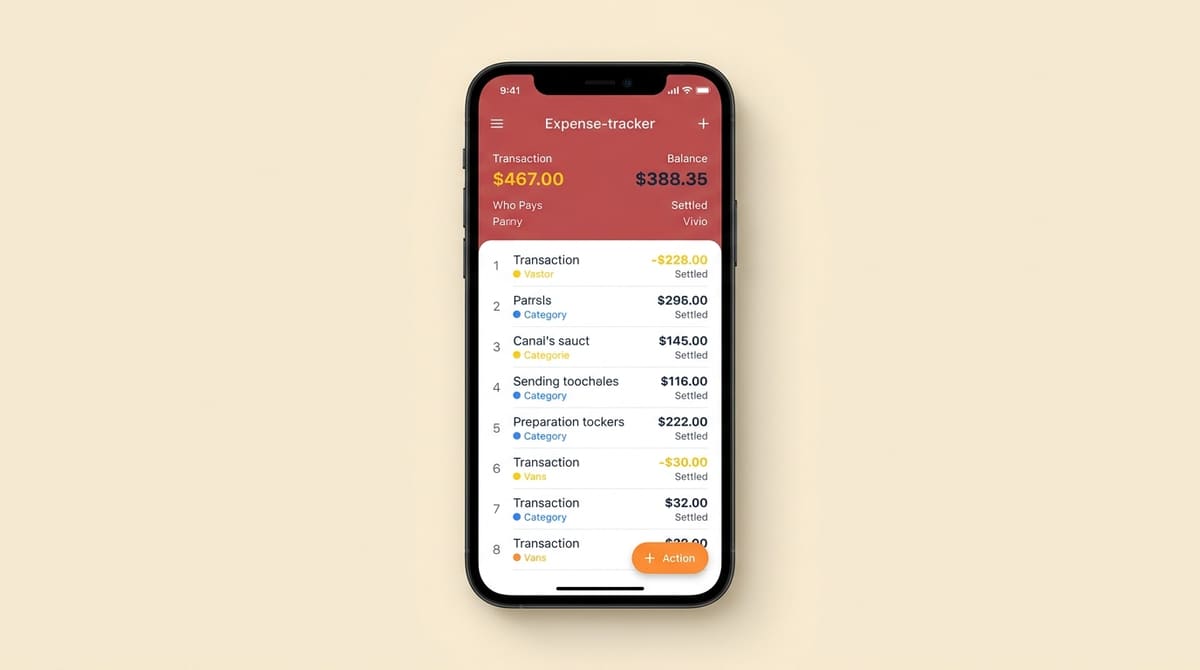
Budget-heavy approach works for short trips, expensive destinations, and groups where people have very different financial situations. Agreeing a number before anyone commits avoids the worst conversation in group travel, which is someone realizing mid-trip that they can't afford the rest of it.
Tracking-heavy approach works for long trips, open-ended travel, and groups that travel together regularly and trust each other. You can't meaningfully budget six weeks of improvised travel to the dollar, but you can watch your running daily average and adjust.
Something worth noting about how tracking usually fails: most expense tools are built around logging every individual receipt, which is fine for a long weekend and exhausting on a three-week trip. By day five, nobody's entering the $3 coffee. What longer trips actually need is a simpler running balance against the daily target. Did today land above or below, and what's the average doing?
That's enough structure to stay on track without turning one person into the group's bookkeeper.
Using a Travel Cost Splitter Instead of a Spreadsheet
A spreadsheet is a fine planning tool and a terrible live one. It lives on one person's laptop, nobody updates it after day two, and currency conversion turns into a mess of manual rates.
A travel cost splitter solves a different problem from a budget calculator: the calculator answers "what will this cost each of us?" before the trip, while a travel cost splitter answers "who owes what?" while it's happening and after it ends. Both matter, and the second one is where friendships actually get strained.
What a decent trip expense split calculator should handle:
- Multiple currencies. Entering spend in local currency and seeing settlements in your home currency removes a whole category of arguments.
- Settlement math. With five people and forty expenses, the raw debt web is a nightmare. A good travel cost split calculator collapses it into the fewest possible payments.
Zedger handles trip money in a dedicated Trip Book, kept separate from your Family Book or Recurring Book, so a vacation doesn't get tangled up with rent and groceries. You add expenses offline and they sync when you're back on signal. Splits can be equal, unequal, percentage-based, or exclude specific people, and Smart Settlements turns the whole tangle into a short list of who pays whom.
If you're weighing options, our guide to the best app for splitting trip expenses compares the practical differences, and the travel expense splitter page covers how Trip Books work in detail.
Common Mistakes When Splitting Trip Costs
A few patterns show up again and again, and all of them are avoidable.
Treating unequal rooms as equal. If one couple takes the master suite and someone else gets the sofa bed, an even split feels unfair fast. Weight the accommodation share by room quality, or agree explicitly that you're splitting evenly and everyone's fine with it.
Forgetting who fronted what. The person who put the rental car on their card is owed that money. If it isn't logged at the moment of payment, it gets forgotten, and they end up quietly absorbing it. Log it when it happens, not at the end.
Splitting personal consumption. Alcohol is the classic case. If two people drink and three don't, splitting the bar tab five ways isn't generous. It's a slow resentment generator. Use exclude-member splits.
Settling only at the end. On trips longer than a week, settle partway through. Smaller balances are easier to pay and easier to dispute while people still remember what the charge was for.
Leaving one person as the accountant. If everyone can see the shared ledger, nobody has to chase anyone. The record does the asking, which is far less uncomfortable than a person doing it.
Get those five right and the math from earlier in this guide holds up in the real world rather than only on paper.
Quick Reference: Your Trip Cost Calculation Checklist
Run through this before you lock the budget:

- Research real flight, accommodation, and food prices, using the third to fifth cheapest listing in your class, not the cheapest.
- Estimate daily spending at roughly twice your nightly accommodation cost, adjusting up for expensive-food destinations and down for self-catering.
- Keep flights in a separate fixed bucket, outside the per-day figure.
- Count nights of paid accommodation, not calendar days, and budget travel-day costs separately.
- Add $20 to $30 per person per day as a buffer, or a tenth to a fifth of the total.
- Divide shared costs by group size, then add each person's individual spending.
- Decide whether you're quoting per-night or per-day, and stay consistent.
- Agree in advance what counts as shared versus personal, drinks, activities, and rooms included.
That's how to calculate trip cost per person without a spreadsheet, a spreadsheet argument, or a group chat full of screenshots.
Start Your Trip Book Before You Book Anything
The estimate is the easy half. Keeping the real numbers straight across eight days, five people, and two currencies is the part that decides whether anyone wants to travel with you again.
Create a Trip Book in Zedger, add your travel companions, and log costs as they happen, offline if you have to. When the trip ends, Smart Settlements tells everyone exactly what they owe, in one short list, with no chasing. The free tier covers four books, ten members, and six months of history, which is plenty for a trip or two a year. Pro is $1 a month if you need more books, more members, or longer history.
- Get It on Google Play
- Download on the App Store
- Start a 7-day free trial of Pro from the pricing page
- Managing travel for a larger organization? Contact Sales
Tags: