What to Do When Someone Refuses to Pay Their Share Back
What to do when someone refuses to pay their share back: ask in writing, escalate in steps, use the group chat as logistics, offset future costs, or let it go.

Arun Andiselvam

You fronted the villa deposit. You covered the rental car because your card was the one on file. You paid for three dinners because splitting the check six ways in a country where nobody spoke the language felt impossible at the time. Everyone said they'd settle up. Five people did. One person has gone quiet.
Send one clear, specific, written request with an exact amount and a date, then give it a reasonable window before you escalate in steps. A nudge in the group chat comes first, followed by an offer to split the payment over time. After that comes a final written notice with a deadline, and only then anything formal. At each step, decide whether the money is worth the effort it costs you. Most of the time, the first straightforward request solves it. The rest of this guide covers what happens when it doesn't.
We'll go through how to tell the difference between someone who can't pay and someone who won't, how to use the group chat without turning it into a public shaming, and how to quietly offset what they owe against future trips. We'll also cover when it's genuinely smarter to write off the money and protect your peace of mind. And we'll cover prevention, because the real fix for group trip payment disputes isn't better collection tactics. It's a setup where nobody fronts a large sum alone in the first place.
First, Figure Out If They Can't Pay or Won't Pay
This is the fork in the road, and almost everyone skips it. The way you handle someone who is embarrassed and broke is completely different from the way you handle someone who has simply decided your money is now their money.

The signals are easier to read than you'd think. Someone who can't pay usually goes quiet, avoids the topic, and gets vague about dates. "Soon," "next month," "after this thing settles." They often respond to everything else you send them and only dodge the money message. Shame makes people disappear. Someone who won't pay tends to argue instead.
There's a third pattern worth naming. The person who genuinely forgot is busy, and the trip ended weeks ago. The amount never got written anywhere they'd see it, and your message landed in a chat they muted. This group is the largest one, which is why your first message should never carry any heat at all.
If you think it's inability, lead with an offer rather than a demand. "No rush, want to split it into two payments?" removes the shame that's keeping them silent, and it very often gets a reply within the hour. If you think it's refusal, stop softening your language. State the amount, state what it was for, state the date you need it by. Clarity is not aggression. Vague politeness is what lets a refusal stretch into months.
One practical way to test which you're dealing with is to offer a small, easy partial payment. Ask for a quarter of it this week. Someone who can't pay will usually take that deal with relief, while someone who won't pay will find a reason that a quarter is also impossible. That answer tells you how much more of your energy this is worth.
How to Ask Someone to Pay You Back Without Making It Weird
Most people overthink the first message so badly that they never send it, then they resent the person for not reading their mind. Being specific fast and warm at the same time is most of the battle.
A good first request has four things in it. It states the exact amount, what it was for, how they can send it, and when you'd like it. "Hey, you're at $218 from the trip (your share of the Airbnb and the car). Can you send it over this week? Same payment handle as before." That's it.
Written beats spoken here, every time. A message creates a record of the amount and the date you asked, which matters enormously if this ever escalates. It also gives the other person room to respond when they have the money rather than being cornered face to face. If you prefer to raise it in person, follow it with a text that repeats the number.
Timing matters more than wording. The window right after the trip, while everyone is still posting photos and the good feeling is intact, is the easiest moment you will ever get. Every week you wait, the memory of the shared expense fades and the request starts feeling like it came out of nowhere. If you're reading this months late, don't let that stop you. Just acknowledge the gap in one line and move on to the number.
When a Friend Won't Pay You Back After the First Ask
So you sent the clear message, and nothing happened. Maybe a read receipt, maybe a thumbs up with no money attached. This is the stage where most people either explode or go silent for a year, and neither works.

The escalation ladder is short. Take it one rung at a time, with real gaps between rungs. Rung one is a single follow-up a week or two later, same facts, slightly shorter. "Just bumping this, $218 for the trip. Can you send it by Friday?" Rung two means changing the channel. If you've been texting, call.
Rung three is making it easier to pay. Offer installments, offer to accept a smaller number if you genuinely think the original split was unclear, or offer to settle by having them cover something of equivalent value. A large round number can feel impossible to someone whose account is already stretched thin, so breaking it into smaller pieces often unlocks payment when a single lump sum won't.
Rung four is the group chat, which gets its own section below because it's the most effective and most misused tool in the whole process.
Hold your tone steady between rungs. Set yourself a limit in advance, too: decide now how many follow-ups you'll send before you stop. Three is a reasonable number for a friend. Knowing where you'll stop is what keeps this from eating months of your attention. It also makes each individual message easier to send because you're not wondering if you'll be doing this forever.
Using the Group Chat: Public Accountability Without the Public Shaming
Here's the most useful thing we can tell you about dealing with unpaid group expenses. Private messages are simple to ignore, and group messages are not. The dynamic is uncomplicated. In a one-on-one thread, ignoring you costs the other person nothing. In a thread with six mutual friends in it, ignoring you costs them their standing in the group. That social weight does the work that your fourth polite reminder couldn't.
There's a right way and a wrong way, and the difference decides whether you get paid or get painted as the villain. The wrong way is naming and shaming, a message that exists to embarrass someone.
The way that works is framing the ask as a group logistics problem, not a character problem. Post the full summary of who paid what and what everyone owes. Name everyone, including the people who have already settled. "Final trip numbers, Priya, Sam, and Alex are settled, thanks! Dan and Mei, you're at $218 and $140. Can we close this out by the weekend?" Dan's name is in there, but it's in there as part of a list, not as a callout. The accountability is real and the humiliation is absent.
Nobody is accused of anything. The person who owes you knows exactly who you mean, and the people who've already paid don't feel dragged into a conflict.
A shared ledger does this work for you without you having to write any of those messages. When everyone can open a Trip Book and see the same numbers, the reminder stops being a person nagging and becomes a fact sitting on a screen. That shift matters more than it sounds. Nobody resents a balance. People resent being asked.
Offsetting Future Debts Instead of Chasing Past Ones
This is the quietest and most underrated strategy in the whole subject of how to collect money owed from friends. Almost nobody writes about it.
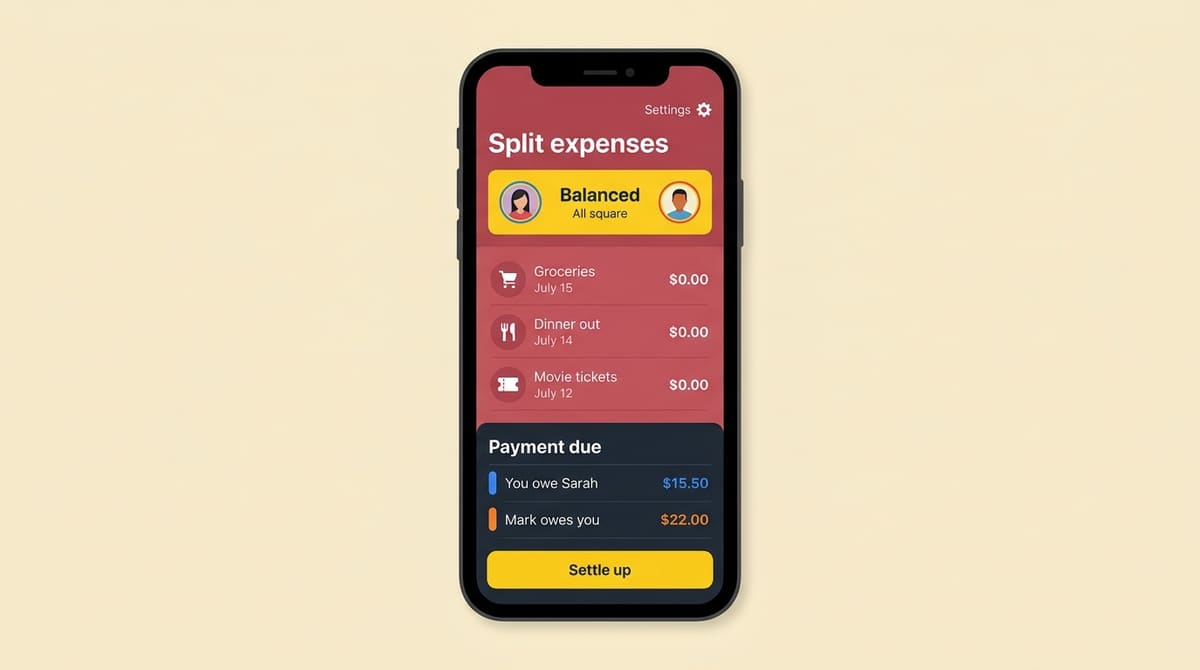
Instead of pursuing the old debt, you stop paying forward. The next time the group goes out and that person covers something, you don't send your share. You point at the outstanding balance and net it off. "I've got $218 of yours from the trip, so take my $40 for tonight out of that." You never had a confrontation, and you never sent a demand. The debt just quietly shrinks every time a new shared expense comes up.
The one condition is that the record has to be clean and visible to both of you. If it's written in a shared Book that both of you can open, the offset is just bookkeeping. Keep the Trip Book open after the trip ends and let the balance carry.
Say it out loud when you start, though. Don't silently stop contributing and let them wonder why you've gone cheap. One sentence, "I'm going to run this against what's outstanding from the trip," keeps it honest and gives them the chance to object or just pay you instead.
There's a limit to this approach: it only works with people you'll keep sharing costs with. For a colleague you'll never travel with again, or a friend who's drifted, there's nothing future to offset against. For those, you're back to the ladder above, or the decision in the next section.
Deciding Whether to Let It Go: An Honest Cost-Benefit
A lot of people carry an unpaid debt for years, not because they expect the money, but because dropping it feels like losing. Letting it go is a legitimate option, not a surrender, and often it's the right one. You are paying with attention for something you could have paid with cash.
Tell them once, plainly, that you're writing it off and you'd rather not have it between you. Then actually write it off. Don't bring it up at Thanksgiving. A debt you've "forgiven" but keep mentioning is worse for everyone than either paying or pursuing.
If the amount is large enough that letting it go would change your month, that's a different conversation and worth the effort. Keep going.
The middle zone is the hard one: meaningful money, but not life-changing. For that, we'd suggest a time limit rather than a money limit. Give yourself a defined window, pursue it properly during that window using the steps above, and when the window closes, close the file either way. Open-ended chasing is what causes the resentment, not the amount.
Protecting Yourself from the Emotional Weight of It
The money is usually the smaller problem. The bigger one is how much space this occupies: the drafting and redrafting, the imagined arguments in the shower, the feeling that asking for what you're owed makes you petty. Distinguish the two things.

Lower the stakes by making the ask boring and repeatable. If every reminder is an emotional event, you'll avoid sending them. If a reminder is just a balance appearing in a shared Book, or a one-line message with a number, you can send it on a Tuesday without ceremony. Systems take the feelings out of it, which is the entire point of having one.
Set a boundary with yourself about availability, and give yourself permission to say the quiet part. "This is bugging me and I'd like to clear it" is a completely reasonable sentence to say to a friend. Most people brace for a blowup that almost never comes. The usual response to a direct, calm statement is an apologetic transfer and an awkward joke, and the thing is over.
Formal Routes: Demand Letters, Small Claims, and Collection Agencies
For most trip debts between friends, none of this applies. But if the amount is substantial, a shared rental deposit, a large booking, a business arrangement that went sideways, you should know what the options realistically cost and return.
Start with a final written notice. Mentioning small claims court as your next step is legitimate and often sufficient on its own.
A lawyer's demand letter is the next rung and is frequently the best value in the entire escalation chain. It costs far less than litigation, it arrives on letterhead that makes the situation feel real, and it often produces payment without anyone setting foot in a courtroom. The formality itself is the leverage.
For a larger debt, a collection agency's cut is a meaningful loss compared to a demand letter or a small claims filing. For a modest one, the fee structure rarely makes sense at all.
Whichever route you consider, your documentation decides your odds. Receipts, a dated record of what was agreed, and screenshots of the requests you sent will do more for you than any amount of righteous indignation. This is general practical guidance rather than legal advice. For anything significant, talk to someone qualified in your jurisdiction.
When to Bring in a Mutual Friend as an Intermediary
Sometimes the fastest route runs through a third person. The reason it works is that it changes who's asking.
When you ask, it's a conflict between two people with history and pride involved. When a neutral friend mentions it, it arrives as a piece of information: "Hey, I think there's still something outstanding from the trip, did that get sorted?"
Pick carefully. The right intermediary is someone who's genuinely neutral and discreet, and not inclined to enjoy the drama. Brief them properly and briefly.
This step has a natural ceiling. If one conversation doesn't move it, thank them and take it back. Repeatedly deploying mutual friends turns into a pressure campaign, and the group starts to find the whole thing exhausting regardless of who's right.
Preventing It Next Time: Build the Trip So Nobody Fronts Everything
Everything above is damage control. The real solution to group trip payment disputes is structural, and it's not complicated.

Split the bookings at the source. Rather than one person putting the villa, the car, and the flights on a single card, assign each major cost to a different person. The exposure gets distributed, and a single non-payer can no longer leave one person thousands of dollars down. Most booking platforms let separate people pay for discrete reservations, and where they don't, a group payment link usually works.
Collect a deposit before anything is booked. This is the single most effective prevention tactic there is. Ask everyone to send a portion of their estimated share before you confirm the house, not the full amount, just enough that they have skin in the game.
Agree the split rules before you leave. Figure out whether drinks are shared or individual. Decide if the person who skips the boat trip still pays for it. Settle whether the couple sharing a room pays two shares or one. Nearly every argument we see about splitting expenses with friends traces back to a rule nobody agreed on in advance. Five minutes in a chat beforehand prevents it entirely.
Log expenses as they happen, not from memory at the airport. Receipts vanish, currencies confuse things, and the person reconstructing it all a week later becomes the accountant nobody wanted to be. Offline-first logging matters here, since you can add a lunch bill in a village with no signal and have it sync when you're back on Wi-Fi.
Settle before you go home. The week after a trip is when willingness drops off a cliff. Run the numbers on the last evening while everyone's together and the good mood is still doing the persuading for you.
What to Do If a Roommate Won't Pay Rent
Shared housing is a harder version of the same problem, because the stakes are legal and recurring rather than social and one-off. The sequence is similar but the timeline is much tighter.
Check the lease first. If you're all named on one lease, you're typically jointly responsible to the landlord, which means their non-payment becomes your problem immediately and in full. If they're subletting from you, you're the one exposed. Knowing which arrangement you're in determines everything else.
Move fast and put it in writing. A rent shortfall compounds: one missed month quietly becomes three while everyone avoids the conversation. Send a written message with the amount, the due date, and what happens next, well before the landlord's deadline rather than after it. Documentation is also what protects you if this ends up involving a landlord or a court.
Talk to your landlord earlier than feels comfortable if the shortfall is real. Most would rather know than be surprised, and some will work with you. And if you reach the point where the arrangement isn't sustainable, start the conversation about replacing the person before the debt grows past what anyone can recover.
Keeping the Record Clean So It Doesn't Happen Again
Almost every one of these situations gets worse because of the same underlying gap: nobody agreed on the number. When the amount is disputed, non-payment becomes defensible. When the amount is obvious and shared, it isn't.
That's the thinking behind Zedger's separate Books. We built it this way because mixing a trip to Lisbon with the electricity bill is how people lose track of what's actually owed.
A few things are worth knowing before you try it. Zedger never asks for bank credentials, UPI access, or OTPs. It tracks and splits, it doesn't touch your accounts. Sensitive data can be stored locally on your device rather than only on servers. Expenses can be logged offline and sync when you reconnect, which matters abroad.
Splits can be equal, percentage-based, unequal, or set to exclude specific members, so the person who skipped the boat trip genuinely doesn't pay for it. Smart Settlements works out the minimum set of transfers to clear everyone's balances, instead of six people sending money in circles. See how Zedger lets you split travel expenses with friends, or compare the best app for splitting trip expenses before you pick one.
The free tier covers four Books, ten members, and six months of history, which handles a trip or a household comfortably. If you need more, longer history, bigger groups, more Books, Pro is $1/month or $8.99/year and VIP is $1.99/month or $17.99/year with unlimited Books and members.
The Short Version
When someone owes you, work out whether they can't pay or won't. Ask clearly, in writing, with a number and a date. Escalate slowly: a follow-up, a different channel, an installment offer, then the group chat framed as logistics rather than accusation. Offset future shared costs against the old balance where you can. Decide on a deadline for your own pursuit and honor it, because a debt you've released costs you less than one you carry indefinitely. Save demand letters and small claims for amounts that genuinely warrant them.
And build the next trip so this can't happen. Distribute bookings, collect deposits up front, agree rules, and keep a shared record everyone can see. That's the whole answer to what to do when someone refuses to pay their share, and the prevention half matters more than the collection half.
Grab the free version and set up your first Book before the next trip gets booked:
Get It on Google Play · Download on the App Store
Running collections for a housing society or a large organization? Contact Sales
Tags: