How to Settle Up After a Trip Without the Awkward Part
How to settle up after a trip: list every expense, agree the splits, net the balances to the fewest payments, then ask for the money with one clear message.

Arun Andiselvam

The trip was great. The group chat is full of photos. Somewhere in that chat, buried under a dozen memes, is a message nobody wants to send. "Hey, so about the money..."
Here's the short version of how to settle up after a trip. Gather every shared expense into one list. Agree on how each one gets split, calculate the net balance for each person, then reduce the payments to the smallest number of transfers. Send one clear message with a deadline. That's the whole process. The rest of this guide covers each step in a way that doesn't cost you a friendship.
That's the real problem. Nobody struggles with the math. People struggle with the asking, and the friction isn't financial so much as social. You don't want to be the person who keeps bringing up money.
So let's fix both sides of it. First the mechanics, then the conversations.
Start With One Honest List of Everything
Before you can split anything, you need a single source of truth. Not four people's camera rolls full of receipts, and not a group chat where someone typed "I got the taxi, 1200" at 2am. One list.
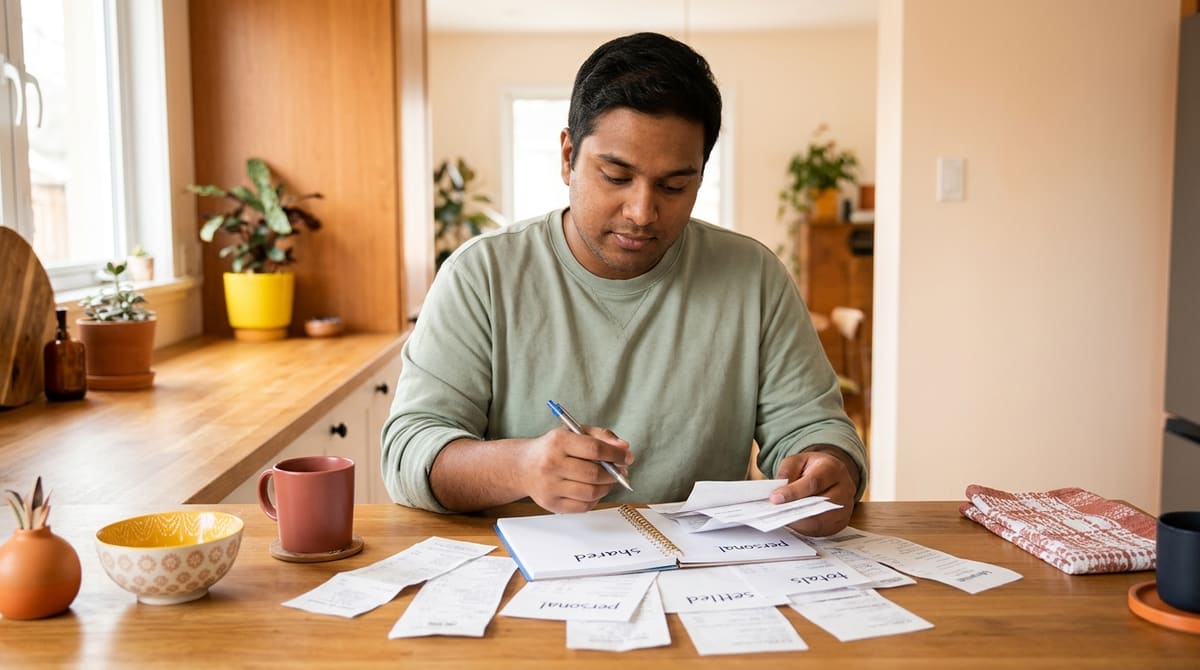
Open a note, a spreadsheet, or a Trip Book in Zedger, and log every shared cost in the same place. For each line, you need four things: what it was, how much it cost, who paid, and who it was for. That last one matters more than people expect.
Go chronologically through the trip rather than by category. It's easier to remember the day you arrived, the day you rented the car, and the day half the group did the boat tour than it is to remember "all the transport costs."
Deposits are the biggest culprit. They're paid so far ahead that they feel like they belong to a separate event entirely.
If you were logging as you went, this step takes ten minutes. If you weren't, give the group a day to add anything missed before you calculate anything. Sending out a final balance and then revising it twice is the fastest way to make people stop trusting the numbers.
Agree on How Each Expense Gets Split
Most groups default to splitting everything equally, and for a lot of trips that's genuinely fine. Equal isn't always fair, though, and unfairness that goes unsaid turns into resentment that comes out six months later.
Four ways to split a line item:
Equal. Everyone pays the same share. Good for shared accommodation, group transport, groceries.
Unequal. Specific amounts per person. Good for restaurant bills where one person ordered the market-price fish and three people had salad.
Percentage. Useful when couples share a room while solo travelers have their own, or when one person stayed two extra nights.
Exclude members. The cost gets split only among the people who were actually there. Essential for optional activities, the skydiving, the spa day, the fancy tasting menu that two people sat out.
Zedger supports all four on any expense inside a Trip Book, which matters because real trips mix them constantly.
The rule that prevents most arguments is simple: decide the split method at the moment the expense happens, not weeks later. Standing outside the restaurant, everyone remembers who had what. Fourteen days later, nobody does, and the person with the best memory wins the argument. That isn't the same thing as the fair outcome.
If you're doing this retroactively and the group disagrees on one line, don't let it hold up everything else. Settle the ninety percent that's uncontested and handle the disputed item separately. Momentum matters more than perfection.
Calculating Who Owes What After a Trip
Here's where people overcomplicate things. It really just comes down to two numbers per person: what they paid, and what they owed.

Add up everything a person paid out of their own pocket. Then add up their share of every expense, based on the split methods you agreed. Subtract the second from the first. A positive number means the group owes them, and a negative number means they owe the group.
Say four of you traveled. Total shared spend was $2,000. If everything split equally, each person's share is $500. Maya is up $600, Daniel is up $100, Sam is down $200, Kofi is down $500. Those four numbers will always add to zero. If they don't, you've missed an expense or double-counted one.
Now comes the part that saves everyone grief. Don't make every debtor pay every creditor. Left alone, that's six separate transfers for a group of four, and it balloons fast, a group of six can generate fifteen. Instead, net it down. Kofi sends Maya $500. Sam sends Maya $100 and Daniel $100. Three transfers, done.
Zedger's Smart Settlements does this netting automatically and shows the minimum set of payments the group needs to make. You tap through them, mark them paid, and the balances update to reflect it. It's the difference between a group trip expense settlement that takes an afternoon and one that takes a month.
One more thing worth building in: if the trip crossed currencies, convert everything to one currency and note the rate you used. Pick one, say which one you picked, move on.
How to Collect Money From Friends After Group Trips
You've got the numbers. Now you have to ask for the money, and this is where most people's resolve quietly collapses.
Send one message to the whole group rather than individual DMs. Group messaging does something private messaging can't: it creates mild, friendly accountability. Nobody wants to be the one name still unhighlighted while everyone else has paid. It also means you only explain the math once.
Make the message plain and complete. Here's the shape of it:
"Hey all, trip totals are in. Full breakdown is in the shared Book, have a look and shout if anything's off. Final balances: Kofi owes Maya $500, Sam owes Maya $100 and Daniel $100. Everyone else is square. Can we get these sent by Sunday? Happy to take any payment method."
Three things that message does well. It points to the evidence, so you're not asking anyone to take your word for it. It states the exact amount per person, so nobody has to do their own math, and it names a date, which is the single biggest factor in whether you get paid.
Be flexible on the method. Some people will transfer instantly, some need a few days, some will want to send it in two parts. Saying "whatever's easiest for you" removes the last excuse. You just mark it settled in the app when it lands.
Ask early, too. The window where people feel warmest about the trip is the few days right after it ends, when the photos are still being shared. Ask then, not three weeks later when the holiday has emotionally expired.
Preventing Payment Disputes Among Traveling Companions
Almost every post-trip dispute traces back to an assumption nobody voiced. Someone thought the rental car included gas. Someone assumed the person who booked the hotel was getting a discount. Someone genuinely believed the dinner they skipped wasn't being split.
The fix is structural, not personal. Log the expense the day it happens, with a note saying who it covers. A line that reads "Rental car, $340, Daniel paid, split between Daniel/Maya/Sam, excludes Kofi" cannot be misremembered. It just sits there, correct, until the trip ends. This is where offline logging earns its place, since that gap is where most missing expenses live.
Second habit: rotate who pays. If one person fronts everything, they end up carrying the whole group's cash flow and chasing four people afterward. Spreading the payments across the group means most people finish the trip roughly even. The final settlement ends up small for everyone.
Third, do a mid-trip check-in. Halfway through, take two minutes to glance at the running balances together. It's low-stakes, nobody's being asked for money yet, and it catches errors while people still remember the details. It also prevents the sticker shock of a final number that lands with no warning.
Communication Strategies for Splitting Trip Costs
Money conversations go badly when they're ambiguous, delayed, or aimed at one person. They go fine when they're specific, early, and aimed at the arrangement rather than the individual.

Talk about budget before anyone books anything. Not in detail, just a rough band. "I'm thinking mid-range, maybe $150 a night for the place" lets someone say "that's a stretch for me" while it's still an abstract conversation and nobody has lost a deposit. Splitting travel costs with friends is far easier when everyone signed up to the same tier of trip in the first place.
Normalize opting out. Say out loud, before the trip, that anyone can skip any activity and won't be charged for it.
That one sentence removes most of the pressure that makes people agree to things they can't afford and then go quiet when the bill arrives. It also makes the exclude-member split feel routine rather than pointed.
Describe the system, not the suspicion. "I'm putting everything in a shared Book so we all see the same numbers" lands completely differently than "I'm keeping track so nobody forgets." Same action, opposite tone. The first is logistics, the second is an accusation wearing a logistics costume.
When you do need to raise something, go after the number instead of the person. "I think the boat tour got split four ways but only three of us went" invites a correction. "You charged me for a tour I didn't go on" invites a defense. People will fix an error much faster than they'll admit a fault.
Written Agreements for Shared Trip Expenses
"Written agreement" sounds heavy for four friends going to the coast. It doesn't have to be. A pinned message in the group chat does the job.
Before you leave, write down and pin the answers to five questions:
- What counts as a shared expense, and what's personal? (Usually: accommodation, transport, groceries, group meals shared. Souvenirs, personal taxis, individual drinks personal.)
- How do optional activities work? (Only the people who go, pay.)
- Who's fronting the big bookings, and when do they get paid back, before the trip, or after?
- What currency are we settling in?
- When is everything due after we get home?
That's it. Five lines, written once, and most of the awkwardness never gets a chance to form. Not a legal document, just a shared memory that doesn't degrade.
The reason this works is simple. Disputes aren't usually about greed. They're about two people honestly remembering a conversation differently. A pinned message makes that impossible, and it does it before anyone has anything to lose by agreeing.
Following Up on Friends Who Owe Money From Travel
Some people won't pay on time, not maliciously. They'll mean to, they'll forget, their pay cycle won't line up, the message will scroll out of view. Here's a sequence that collects the money without turning you into a debt collector.
The reminder. A few days after the deadline, one light message in the group: "Quick nudge, still waiting on a couple of these, let me know if there's an issue." No names. Most people pay here.
The direct message. Private means they're not embarrassed, which makes them more likely to respond, not less.
The offer. If they still don't pay, the problem is probably that they can't right now. Say so first: "Totally fine if money's tight, want to do half now and half next month?" This single move resolves more stuck balances than any amount of chasing.
The decision. What you shouldn't do is keep hinting. Hinting damages the friendship and doesn't recover the money.
Throughout all of it, the record does the arguing for you. When both people can open the same Book and see the same breakdown, the conversation stays about scheduling rather than facts. Among the most valuable trip expense reimbursement tips is simply this: never be the only person holding the numbers.
Make the Next Trip Easier Than This One
Everything above gets dramatically shorter if you set things up before you go. Proactive cost-splitting means the settlement is a formality, not a project.

Create a Trip Book before the first booking and add everyone to it, so the deposit gets logged the day it's paid rather than reconstructed later.
Keep it separate from your household or roommate tracking. Zedger uses separate Books for exactly this reason, so a Family Book or Recurring Book for rent and utilities never bleeds into your trip numbers. Mixed-together expenses are how budgets lose their meaning.
Log as you go, offline when you have to. Agree splits at the moment of spending. Rotate who pays. Check balances midway. Then, when you land back home, settling up trip expenses is one tap on Smart Settlements and one message to the group.
On cost, Zedger's free tier covers four Books, ten members, and six months of history, which handles a typical trip group comfortably.
If you're weighing up tools, our comparison of the best app for splitting trip expenses walks through the trade-offs, and our travel expense split app page covers how Trip Books work in detail. To estimate costs before you go, see our guide on how to calculate trip cost per person.
The money part of a trip should take ten minutes and leave everyone on good terms. It usually can.
Get It on Google Play · Download on the App Store · Start a 7-day free trial of Pro, or contact sales if you're organizing for a larger group.
Tags: