How to Split Bills With Friends: Methods That Keep the Peace
How to split bills with friends without the awkwardness: even, itemized, proportional or turn-taking, plus handling restaurants, trips, birthdays and rent.

Arun Andiselvam
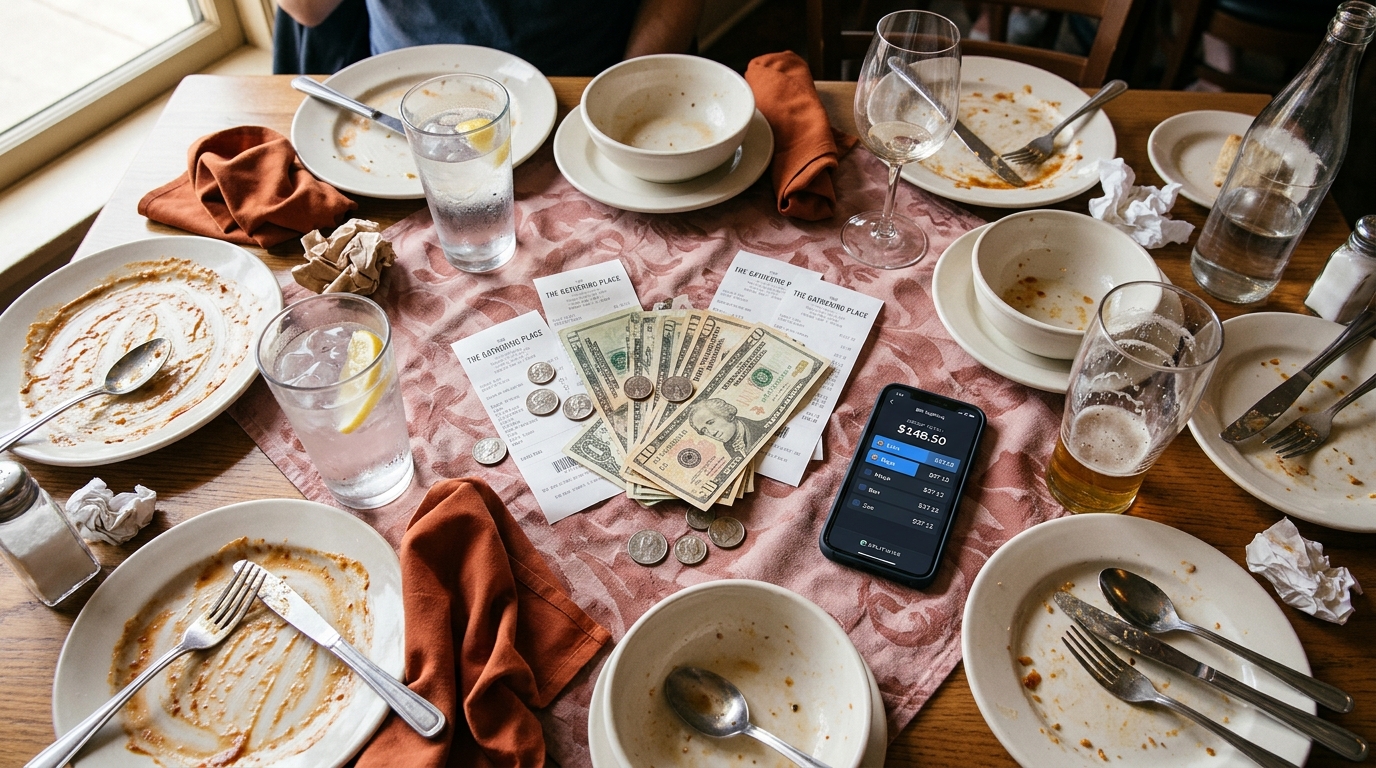
Nobody plans for the moment at the end of a great dinner when the check lands and everyone goes quiet. Somebody picks it up, scans it, does some mental math, and says the thing that kills the mood: "Should we just split it evenly?" Half the table nods. The person who had a salad and tap water nods too, a little slower.
Figuring out how to split bills with friends isn't really a math problem. The math is simple. What's hard is doing it in a way that feels fair to everyone at the table, every time, without anyone keeping a quiet scorecard in their head. Most disagreements over money start as something smaller: an assumption nobody said out loud, and fixing that takes more than knowing the right math.
We built Zedger because this stuff comes up constantly. Spreadsheets don't fix the awkward part. Before we get to apps, let's talk about why the awkwardness exists at all.
Why splitting bills with friends gets awkward in the first place
Three things make group money messy, and none of them are arithmetic.

The first is the default payer. In almost every friend group there's one person who puts the card down first, because they're organized, or because waiting feels rude. Over months and years, that role wears on people. You're floating money you may or may not get back. You're the one who has to bring it up, and bringing it up makes you feel petty about your own money. It's a real financial and emotional drain, and it's usually invisible to everyone else in the group.
The second is the loan-versus-split confusion. When one person covers something, is that a shared cost being settled later, or a favor? Friends rarely say which one they mean. One side thinks "I'll get the next one," the other side is quietly waiting for a transfer. Neither person is wrong. That mismatch is where resentment grows.
The third is travel. Trips compress weeks of shared spending into a few days: cabs, hotels, entry tickets, groceries, that one dinner someone upgraded. By day four, nobody remembers who paid for the boat, and asking feels like an accusation.
Once you see these three patterns, the fixes get obvious. Decide the method before the spending starts, write things down as they happen, and settle regularly instead of in one giant reckoning at the end.
The best way to split bills with friends depends on what you're splitting
There's no single answer. There are four methods that cover almost every situation.
Even split. Everyone pays the same amount. It fails the moment orders differ wildly.
Itemized split. Each person pays for what they consumed, with shared items like appetizers divided across whoever ate them. It's the fairest option and the most accurate. It's also the one people avoid because it feels like accounting. An app removes that objection entirely, which we'll get to.
Proportional split. People contribute by share of income or by usage rather than by head. Roommates use it too when bedrooms are very different sizes.
Taking turns. One person covers the whole thing this time, someone else next time. No math at all, which is the appeal.
The best way to split bills with friends is usually a mix: even splits for things everyone uses equally, itemized for restaurants, proportional for anything tied to income, and turns for small, frequent spending like coffee. What matters more than the method is that the group agrees out loud which one is running. Silent assumptions are the actual problem.
How to ask for separate checks without the awkwardness
Here's the single most useful habit in this entire article: tell the server at the start of the meal, not the end.

The moment you sit down and the server takes the first round of drinks, say it plainly: "Could we get distinct checks, please?" Servers aren't annoyed by individual checks. They're annoyed by being asked to reconstruct them afterward.
If you're the one organizing, make the request before anyone else has a chance to feel weird about it. "Discrete checks for us, thanks" lands as logistics, not as a judgment on anyone's budget.
Some restaurants won't do it, especially large groups, set menus, or busy nights, so have a fallback ready. The cleanest one is a single payer plus instant transfers, with the amounts worked out on a phone while the card is being processed. That's where a bill splitting app for restaurant tabs earns its keep. You enter the items, assign them, and everyone gets their number before the server is back with the receipt. No one is standing around doing division out loud.
Handling unequal orders, expensive dishes, and over-ordering
Even splits are fine until someone orders the ₹1,200 seafood platter and two cocktails while you had a bowl of soup. Pay that difference once and it's nothing. Pay it twenty times across a year and it's real money you quietly handed to someone else.
What makes this uncomfortable is a pattern worth naming. The loudest voices for "let's just split it evenly" are very often the people who ordered the priciest things. Calling it rude to calculate individual costs is a convenient position when the calculation wouldn't go your way. It leans on social pressure to make the rest of the table subsidize somebody's choices. You don't have to accuse anyone of doing it on purpose, since plenty of people genuinely don't notice. But you also don't have to pretend the pattern isn't there.
Non-drinkers and the bar tab. This is the sharpest version of the same issue. Alcohol is often the single biggest line on a restaurant bill, and a non-drinker splitting evenly is paying for rounds they didn't touch. The fix is a standing rule rather than a one-night argument. Drinks get their own tally, food gets split however the group prefers. Set it once, apply it every time, and it stops being personal. If you don't drink, say it at the beginning of the night, "I'll cover my food, you all settle the bar between you," not when the bill arrives.
Deliberate over-ordering and free-riding. Occasionally someone works out that an even split means they can order whatever they want at a discount. Group dynamics being what they are, the other people usually swallow it rather than start something. The way out isn't confrontation at the table. It's changing the default. Once your group runs on itemized splits as the norm, over-ordering costs the over-orderer, and the behavior quietly disappears. Switch the system, not the person.
When incomes differ. If a friend or partner earns significantly more and even splits strain you, the honest conversation beats silent resentment every time. Keep it about the structure, not about anybody's worth. "Even splits are tight for me right now, can we do what we each ordered, or pick places in a lower range?" Most people say yes immediately. The ones who don't have told you something valuable.
The cash-in-the-middle method
Low-tech, old-fashioned, and surprisingly effective. Before the food arrives, everyone puts an agreed amount of cash in the middle of the table, and the pile pays the bill. Whatever's left over gets split back or rolls into the tip.
The appeal is that it removes the end-of-night negotiation completely. There's no single person fronting the money, nobody is chasing transfers the next morning, and the amount is visible to everyone, which keeps the ordering honest. It also works well for groups that include people who don't use digital payments, and for cash-only places.
The limits are real too. You need people to actually carry cash, which is less common than it used to be. And it does nothing for the record-keeping problem, since a week later nobody can tell you what that evening cost.
A sensible modern version is the shared kitty. One person collects an agreed amount from everyone up front, holds it, pays for things out of it, and logs each payment as it happens. The transparency is what makes it work. A kitty nobody can see is just a loan in disguise.
Taking turns paying the full bill: simpler, but conditional
Plenty of friend groups skip splitting entirely. You buy this round, I'll buy the next one. Over a year it roughly evens out, and the friendship stays free of arithmetic.
We like this method and we'd recommend it, with conditions. It only holds up when three things are true. Everyone has broadly similar spending power, so no one is stretched by covering a whole bill. The outings are similar in size, so "your turn" doesn't mean a ₹400 coffee one week and a ₹4,000 dinner the next. And the group actually meets often enough for the cycle to complete, since turn-taking with someone you see twice a year is just a slow-motion debt.
Where it breaks is predictable. Someone forgets whose turn it is. Somebody skips a few rounds. The person with the biggest income keeps grabbing the check, which feels generous at first and starts to feel like a status thing later. That same default payer we mentioned earlier ends up carrying more than their share without ever saying so.
If you want turn-taking without the drift, keep a light record, not a ledger of debts, just a running note of who covered what, so that when someone says "wasn't it my turn?" there's an answer instead of a guess. That's the whole point of tracking without debt-style balances. You get the memory without the pressure.
Birthday dinners, farewells, and who covers the guest of honor
Special occasions have their own etiquette, and getting it wrong sours an otherwise lovely night.

The common default is that the birthday person doesn't pay, and the rest of the table splits their share. It's a nice gesture, and it works fine for a small group at a mid-range place. It stops working when the group is large, when the venue is expensive, or when the birthday person orders freely because they're not paying, and suddenly everyone else is covering a premium meal plus a share of someone else's champagne.
A few things make this smoother. Decide before the booking, not at the table: whoever organizes should say in the group chat, "we're covering Priya, works out to roughly X each, shout if that's a problem." That gives anyone who's tight on money a private way to opt for a smaller contribution instead of being cornered publicly. Pick the venue with the group's budget in mind, not just the birthday person's taste.
If the celebrant is the one choosing a pricier place, it's entirely fair for them to pay their own way. The alternative that avoids all of it: everyone covers themselves, and the group buys a gift or the cake instead. Same warmth, no mystery total.
Splitting bill apps on a trip: what changes when you travel
Trips break every casual system. There are more transactions, more payers, and more fatigue. The person who said "I'll remember" on day one will not remember on day five.
What actually works is logging each expense the moment it happens, in the cab, at the counter, on the hotel steps, rather than reconstructing everything at the airport. Bill splitting apps on a trip only help if entries go in live, which means the tool has to be fast enough to use with one hand while someone holds a suitcase.
Two features matter more than anything else here. Multi-currency support, so a shared ride in Bangkok and a hotel booked in rupees sit in the same book without manual conversion. Offline entry, because the places worth traveling to are often the places with no signal. Zedger lets you add expenses with zero connectivity and syncs them automatically when you're back online.
Settlement matters too, netting everything down instead of generating a dozen separate repayments. Our Smart Settlements works out the smallest set of transfers that clears the group. The last trip habit worth building is mid-trip settling. Clearing balances every couple of days keeps any one person from floating thousands of rupees, and it turns the final night into a dinner rather than a reconciliation meeting. A dedicated Trip Book keeps those costs separate from everything else you track, so your holiday spending never gets tangled with your rent.
Rent, utilities, and the regular bills roommates share
Shared flats are the hardest version of this problem because the bills never stop. Rent, electricity, water, and internet repeat every single month. Manual re-entry is the reason most roommate systems collapse by month three.

The fixes are structural. Agree on the split method for each category up front and write it down: rent by room size or evenly, utilities evenly, groceries by whoever actually uses them. Set one settle day a month so nobody has to ask anyone for money, and let the date do the asking instead. Rotate who pays which bill so one person isn't permanently fronting the whole flat. And automate the repeating entries so that rent appears every month without anyone typing it.
That's exactly what a Recurring Book handles in Zedger, and it's the core of our bill splitting app for roommates, fixed monthly costs set once, logged automatically, settled on schedule. If you're weighing options before committing, we've compared the main choices in our guide to the best bill splitting app for roommates, including where each one gets fiddly.
When you live with the people you're splitting with, the best way to split expenses with friends is the one that requires the least ongoing effort, because effort is what fails.
Why a group bill splitting app beats a spreadsheet
Plenty of people build their own systems: a shared sheet with formulas, a column per flatmate, maybe an automated reminder wired in.
A purpose-built app solves the same problem without the maintenance. Entries take seconds, splits update automatically as you go, everyone sees the same numbers, and nobody has to be the spreadsheet's owner. A good bill splitting app for friends also removes the social cost of itemizing. When the phone does the math, asking for an itemized split stops feeling like a statement about anyone's generosity.
What we do differently in Zedger is keep things in separate Books rather than one long mixed list. A Family Book for the household, a Trip Book for each holiday, a Recurring Book for rent and utilities. Trip costs never contaminate your monthly bills.
We also don't ask for bank credentials, UPI access, or OTPs. There's no bank linking at all, data is encrypted, we don't sell it, and you can choose to keep sensitive information stored on your device. For anyone wary of handing over account access just to settle a dinner, that matters.
It's deliberately uncomplicated: four focused tools, not a wall of features. The free plan covers six months of expense history, four books, and ten members per book, enough for most groups indefinitely. The trial needs no card, and you can downgrade whenever you like.
An app for splitting bill with friends on a weekend away, a bill splitting app for restaurant nights out, and something that quietly handles rent every month are really the same tool wearing different hats. Let the tool carry the awkward part so the friendship doesn't have to.
GET IT ON Google Play · Download on the App Store · Managing a housing society or a large group? Contact Sales.
Tags: