How to Split Utility Bills with Roommates (Without Fights)
How to split utility bills with roommates: equal, usage-based, or flat monthly. Covers the electric bill, travel absences, free-riding and tracking it all.

Arun Andiselvam

Rent is the easy part. Utilities are where shared living gets messy. The electric bill doubles in May, someone was away for three weeks, and the person who keeps the AC at 18°C goes quiet in the group chat.
Figuring out how to split utility bills with roommates isn't really a math problem. It's an agreement problem, and the math takes thirty seconds. The disagreement can take months. This guide walks through the methods that hold up over a full lease, the situations that break them, and how to keep a record everyone trusts.
The Three Methods, and When Each One Breaks
There are only three real methods. Most households end up using some combination of them.
Split everything equally. Four people, one bill, divide by four. It's fast and predictable, and it's the default for a reason. Nobody has to audit anybody. The weakness is obvious: if one person works from home all day with the air conditioning running and another is out twelve hours a day, the equal split quietly subsidizes the heavier user.
Split by usage. This feels fairer on paper. In practice, it's hard to measure anything except in rough proportions, because your electricity meter doesn't tell you who ran the geyser.
Bundle utilities into a flat monthly amount. Instead of chasing the real bill each month, everyone pays a fixed figure, say $1,500 per person, into a shared pot, and bills get paid from it. This method is underrated. It removes the monthly negotiation entirely and makes budgeting predictable, and the surplus from mild months covers the brutal ones. The only requirement is that you set the number honestly and review it.
The best way to split utilities with roommates in most shared apartments is a hybrid. Use an equal split for the genuinely shared services, like internet and water, and a flat bundled amount with a buffer for electricity, which is the volatile one. That approach gives you fairness where it matters and simplicity everywhere else.
How to Split the Electric Bill with Roommates Without Starting a Cold War
Electricity is where almost every roommate dispute begins. It's the only utility whose cost swings wildly with behavior. Deciding how to split electric bill with roommates fairly means dealing with the base load, the seasonal spike, and the person who disagrees with your thermostat.
Start by separating base load from variable load. Fridge, router, lights, fans, water pump, that runs regardless of who's home and should be split equally. Nobody gets a discount for not using the fridge. What's left is mostly cooling and heating, and that's the part worth talking about.
Here's a practical detail worth knowing before anyone argues about it: setting a thermostat to a fixed, reasonable temperature and leaving it there uses less energy than switching the AC on and off repeatedly. The on-off cycle creates bigger temperature swings, and the unit works harder pulling the room back down each time. So the roommate "saving money" by killing the AC every time they leave the room could be adding to the bill. Agreeing on one setting, with 24-25°C a common landing spot, is both the cheaper and the calmer option.
One more thing we've noticed about these disputes: the amount in question is usually tiny.
Travel, Absences, and What Roommates Owe When They're Not There
This is the question nobody settles in advance and everybody fights about later. A roommate goes home for six weeks in the summer, or takes a long work trip, and comes back to a bill they don't think they should pay.
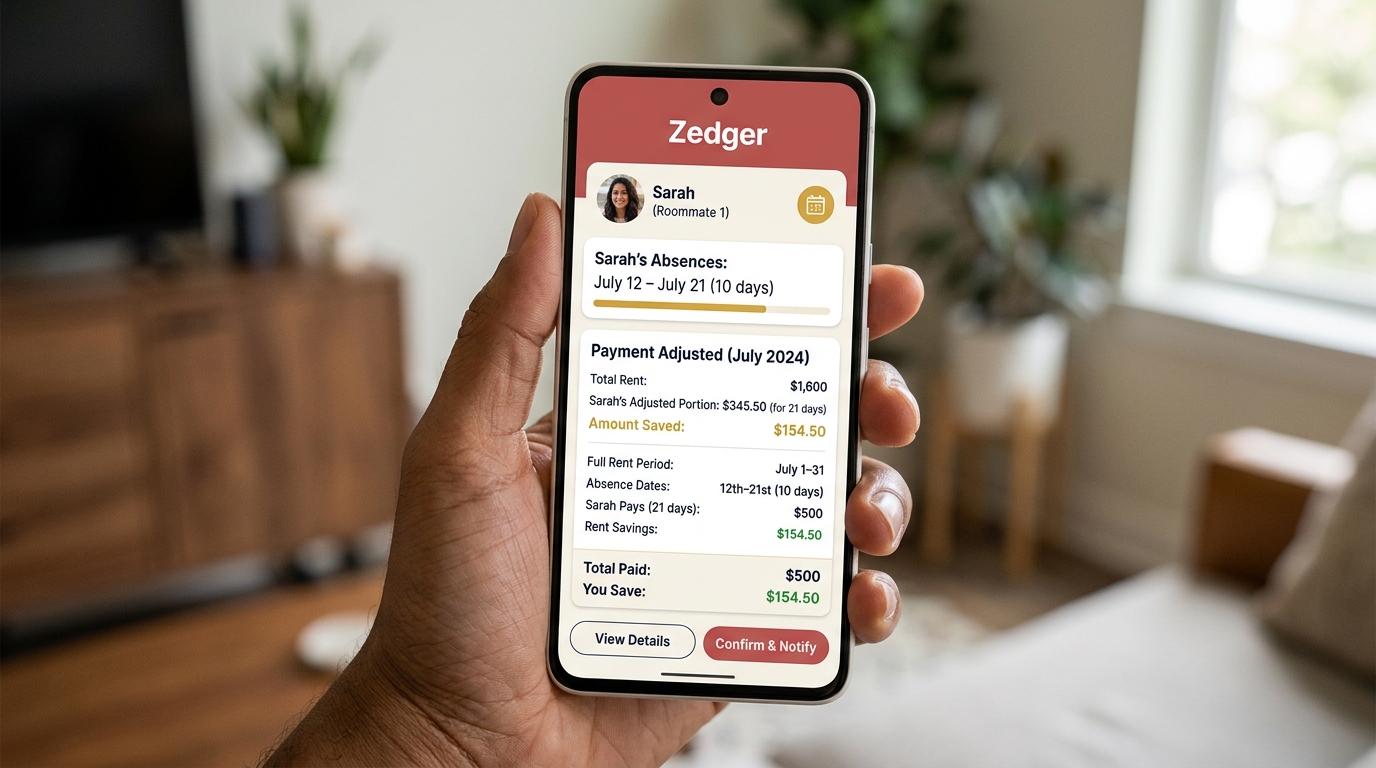
Separate two things here: the lease, and the courtesy. If someone's name is on the lease, they are generally on the hook for their share of the obligations named in it, including utilities in their name, for the whole term. Being physically absent doesn't suspend that obligation. We're not giving legal advice, and your rental agreement is the document that actually governs this, so read it. As a working assumption though, absence doesn't cancel the contract, and the apartment is still being held for them while the fridge keeps running.
What's negotiable is the variable portion. A reasonable and increasingly common arrangement has absent roommates paying their full share of fixed costs, like rent and internet, and a reduced share of consumption-heavy utilities for the weeks they're genuinely away. Fifty percent of the electricity share for a full calendar month of absence is a clean, defensible number. Anything shorter than two weeks isn't worth recalculating.
The trick is agreeing on this before anyone travels, not after the bill lands. If someone's planning a long absence, raise it a month ahead and get the number written down somewhere all of you can see it.
Free-Riding, Room Size, and Renegotiating Mid-Lease
Free-riding is the uncomfortable one. It looks like a roommate who enjoys the cooled living room and the hot water, but argues their share should be lower because they "use less." If someone benefits from a shared utility while declining to fund it at the same rate, that's not frugality. It's being carried by everyone else.

The response isn't a lecture. It's a principle: whatever logic you apply to one utility, apply to all of them. If electricity gets split by usage, then water, cooking gas, and the washing machine get tracked the same way. Most people proposing a usage-based cap on one bill lose enthusiasm once the rule applies across the board.
Common adjustments include utilities split per person rather than per room, while rent stays per room. Or rent weighted by room size and square footage, with utilities split per head. Both are defensible. What isn't defensible is everyone silently resenting it for eleven months.
To renegotiate mid-lease without a blow-up, keep it structural rather than personal, and pick a neutral moment rather than the day a big bill arrives. Propose a trial: "Let's try per-person utilities for two months and look at the numbers again." Trials are simple to agree to because they're reversible. If you're moving in with someone new, confirm temperature preferences, work-from-home schedules, and travel plans in the first week. Those three questions prevent most of what's in this article.
Setting a Buffer, and Tracking It Without Spreadsheets
Seasonal variation is the thing that wrecks flat-rate systems. Electricity in peak summer can run two to three times a mild month. If you set your flat contribution at the average of three pleasant months, the pot runs dry in May, and everyone's suddenly paying a surprise top-up.
Build the number properly instead. Take twelve months of bills if you can get them, average them, then add roughly 10-15% as a buffer. Collect that fixed amount monthly, pay actual bills from it, and let the surplus ride through winter to cover summer. Review it twice a year, once before peak summer and once after, and refund or adjust the surplus. Announce the review date when you set the system up so nobody feels ambushed by a change.
The part that fails isn't the math. It's the record. Somebody pays the internet on their card, somebody else pays the electricity in cash, and by month four nobody remembers who's ahead.
This is exactly what Zedger is for. You keep a Recurring Book for rent and monthly bills so the repeat entries don't need retyping, and Smart Settlements works out the minimum number of transfers to square everyone up instead of four people paying each other in circles. The free plan covers four books, ten members per book, and six months of history, which is more than most households need. Pro is $1/month if you want longer history.
If you're comparing options first, we've put together an honest look at the best bill splitting app for roommates, and our bill splitting app for roommates page shows how the Regular Book handles monthly bills. Knowing how to split utilities with roommates is half the job. Having a shared record everyone can check is the other half.
GET IT ON Google Play · Download on the App Store · Managing a housing society or a large building? Contact Sales.
Tags: