How to Split Household Bills Fairly: Methods and Examples
How to split household bills fairly: even, income-based or usage-based, with a worked income split example, a script for the conversation and a way to track it all.

Arun Andiselvam

By the end of this article, you'll have a method you can actually use. It covers whether your household splits bills evenly, by income, or by usage. There's a simple script for the conversation, worked examples with real numbers, and a system for tracking it all so nobody has to keep a mental tally.
Most money arguments at home aren't really about money. They're about the feeling that someone is getting away with something. The electricity bill arrives, somebody mutters about the air conditioner, and suddenly a ₹3,400 bill becomes a referendum on who respects whom. That's why learning how to split household bills fairly matters more than the arithmetic itself. Fairness is as much about agreement as it is about the final number.
Step 1: List every shared bill before you argue about any of them
Start with a complete inventory. Write down every recurring cost that touches the household. That means rent or EMI, electricity, water and gas, internet, mobile plans if they're on a shared account, society maintenance, domestic help, groceries, streaming subscriptions, cleaning supplies, and any loans tied to the home.

Then mark each one as shared, partly shared, or individual. Internet is shared, and groceries are usually shared too. A gym membership isn't, and petrol for one person's commute usually isn't either, even if it feels like a household cost.
This sounds obvious, but skipping it is the single most common mistake we see. Households argue about the electricity bill for months without ever noticing that one person quietly pays the entire society maintenance charge out of their own account. You can't divide a pie you haven't measured.
For blended families, this step does extra work. When one partner brings children from a previous relationship into a shared home, there's often real uncertainty about which costs count as "household" and which belong to one parent. School fees, kids' clothes, and tuition classes need deciding explicitly, together, before the bills arrive. Leaving it unsaid is what breeds the resentment, not the costs themselves.
Add a line at the bottom called "things we forgot," because you will forget something, and you'll want a place to put it without reopening the whole negotiation.
Step 2: Pick your splitting method. Even, income-based, or usage-based
There are three honest ways to divide shared costs, and each one is fair in a different sense.
Even split. Everyone pays the same rupee amount. It's clean, fast, and needs no spreadsheets. It works best when incomes are similar and the household is a set of adults who use the home roughly equally, which is classic roommate territory.
Income-based split. Each person pays a share proportional to what they earn. This is the method most couples drift toward when one partner earns significantly more than the other. It's also the question we see households wrestle with most: should bills be split equally or in proportion to income? There's no universal answer, but there is a useful test. If an even split leaves one person with almost nothing left after bills while the other has plenty, the even split isn't actually equal. It just looks equal on paper.
Usage-based split. You divide based on who consumes what. Think of a three-person flat where one roommate runs the AC all night and another is barely home. Usage-based splitting is the fairest in theory and the fiddliest in practice, which is why it works best for one or two specific bills rather than everything.
Most households end up with a hybrid: rent per room, utilities even or by income, groceries even, and personal subscriptions kept separate. That hybrid approach tends to survive longer than any single rule applied across the board.
Pick a method per bill category, write it down, and leave it alone until your scheduled review.
Step 3: Run the numbers for an income-based split
Here's the arithmetic, and it's simpler than it sounds. Add up both incomes, work out each person's percentage of the total, then apply that percentage to the shared bills.

Say Priya takes home ₹70,000 a month and Arjun takes home ₹30,000. Together that's ₹1,00,000. Priya's share is 70%, Arjun's is 30%.
Their shared monthly bills:
| Bill | Amount | Priya (70%) | Arjun (30%) |
|---|---|---|---|
| Rent | ₹25,000 | ₹17,500 | ₹7,500 |
| Electricity | ₹3,400 | ₹2,380 | ₹1,020 |
| Internet | ₹1,200 | ₹840 | ₹360 |
| Groceries | ₹12,000 | ₹8,400 | ₹3,600 |
| Maintenance | ₹2,400 | ₹1,680 | ₹720 |
| Total | ₹44,000 | ₹30,800 | ₹13,200 |
Under an even split, each would pay ₹22,000. That would leave Arjun with ₹8,000 for everything else in his life while Priya kept ₹48,000. The proportional version leaves them both with roughly the same breathing room relative to what they earn.
Equal pain, not equal payment, is the whole point of this approach.
A few practical notes follow. Use take-home pay, not gross, since nobody spends their CTC. Recalculate when someone's income changes meaningfully, not every month. And if one person has debt the other doesn't, you can either ignore it, since it's their obligation, or factor it in by using "income after fixed debt payments" as the base. Just decide which, and apply it to both people.
Keeping income secret while demanding a proportional split undermines the whole method. This method only works if both people share actual numbers. If that feels uncomfortable, say so out loud, since it's a reasonable thing to feel, and it's better addressed than silently resented.
Step 4: Handle the utility fights. AC, travel, and who's actually home
Utilities cause more friction than rent, and it's always the same two arguments.
The first is the AC argument. One roommate runs cooling heavily, another insists they shouldn't subsidize it, and the bill becomes a standoff. The thing worth saying plainly is this: during a genuinely hot stretch, AC isn't a luxury indulgence, it's basic livability. Framing a flatmate as greedy for wanting to sleep is a fast route to a broken household. If one person's usage is genuinely far beyond everyone else's, say a dedicated room unit running constantly, a gaming rig, or an aquarium, then meter it or agree on a flat add-on for that person, and move on.
The second is the time-at-home argument. Someone travels for work three weeks a month, or someone else works from home all day. Adjusting the split can be fair, but only if you apply the same logic everywhere. If you discount electricity for the person who travels, you also have to look at water, gas, and everything else they're not using. Picking one utility to split by usage while leaving the rest even is where the sense of unfairness comes from, not the split itself.
Our practical default for shared flats is this: utilities split evenly per person, thirds in a three-person household, and rent per room, with equal-sized bedrooms paying the same. Deviate from that only when the gap is big enough that everyone can see it without a spreadsheet.
Installing a usage-tracking regime so detailed that it costs more goodwill than money defeats the purpose. If you're arguing over a few hundred rupees a month, the tracking isn't worth the tension. For more on utilities specifically, see our guide on how to split utility bills with roommates.
Step 5: Have the conversation before the bill, not after
The hardest part of splitting bills isn't the math. It's saying "I don't want to split this one evenly" without sounding cheap. People genuinely struggle to find that sentence, so here's one that works: "I'd rather we split this by what each of us used, because otherwise I'm paying for something I didn't take part in. Does that work for you?"
That's short and specific, with no accusation in it. Lead with the principle, not the person.
A few things make these conversations easier:
- Schedule them. A monthly ten-minute check-in beats an ambush at the dinner table.
- Talk before the expense, not after. Agreeing how to split a new appliance purchase takes two minutes beforehand and two weeks of sulking afterward.
- Name the system, not the person. "Our utilities method isn't working" lands very differently from "you use too much power."
Multigenerational households need this conversation most. When parents, adult children, and grandchildren share a roof, contributions are often uneven by design. One generation might contribute money, another time and caregiving. That's perfectly fair, as long as it's acknowledged out loud. The resentment in these homes almost never comes from the imbalance. It comes from the imbalance going unnamed for years.
Waiting until you're already annoyed is the thing to avoid here. Anger makes a reasonable request sound like an accusation.
Step 6: Track it somewhere neutral, so nobody keeps score in their head
Once you've agreed on a method, the last job is making sure nobody has to remember anything. Mental ledgers are where fairness goes to die, since two people remember the same month completely differently, and both are sincere.
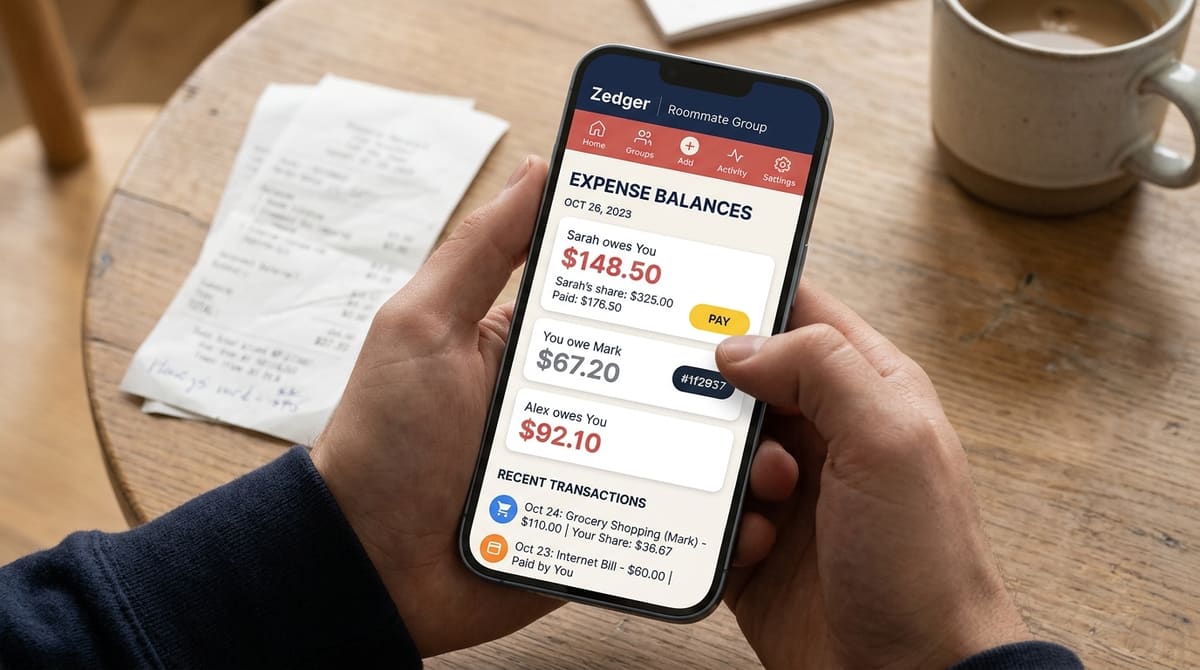
A shared tracker fixes this problem. The reason we built Zedger around separate Books is exactly this: your monthly household costs shouldn't sit in the same list as last year's Goa trip. A Family Book holds the household spending, a Recurring Book handles rent and subscriptions that repeat every month without re-entering them, and a Trip Book keeps holidays separate. Smart Settlements then works out the minimum set of payments needed to square up, rather than everyone paying everyone.
Two things matter when choosing a tool for shared household money. First, it shouldn't need your bank login. Zedger never asks for bank credentials, UPI access, or OTPs, and you can keep data on-device if you prefer.
Second, it should work when signal doesn't, which is why entries sync automatically once you're back online. Many families already use it for exactly this, and the free plan covers 4 Books, 10 members per Book, and 6 months of history. Pro is $1/month and VIP is $1.99/month if you need more.
If you're comparing options first, our roundup of the best family budgeting apps walks through what to look for, and the family expense tracker page explains how the household Book works in practice.
Tracking in a group chat is worth avoiding too. Messages scroll away. A shared ledger doesn't.
Fair doesn't mean identical. It means everyone understands the rule, agreed to it when they were calm, and can check the numbers whenever they want.
Ready to stop keeping score in your head? GET IT ON Google Play or Download on the App Store. Running a housing society or a larger group? Contact Sales.
Tags: